Appearance
Execution Context
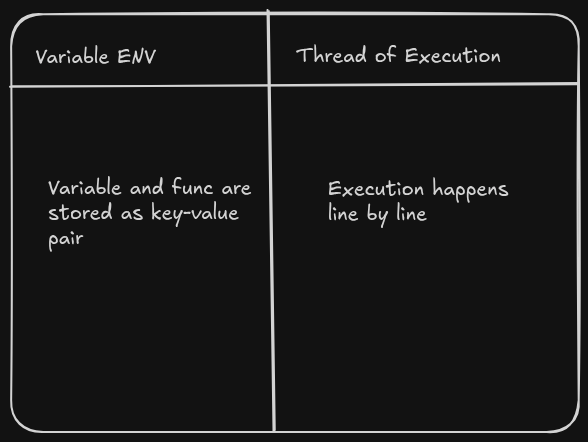
- When we run a JavaScript program, an execution context is created.
- Everything in JavaScript happens inside an execution context.
- JavaScript is loosely typed.
- JavaScript is single-threaded and synchronous; it can execute one line at a time in a specific order.
Execution Context Phases
- Memory creation phase:
- All variables are defined with
undefinedas a placeholder. - In the case of a function, the entire function code is stored.
- An arrow function is also given the value
undefined.
- All variables are defined with
- Code execution phase:
- Code is executed inside the execution thread.
Hoisting
- Hoisting means JavaScript moves declarations to the top of their scope before the code runs.
- Formal definition: Hoisting means declarations are processed during the memory creation phase before code executes, which is why variables exist as
undefinedand functions are fully available before their line is reached.
Call Stack
- When a function is invoked, a brand-new execution context is created inside the original execution context.
- After the function is executed, or the program is finished, the execution context is deleted.
- To simplify the creation and deletion of execution contexts, JavaScript has its own call stack.
- When a program is invoked, the entire global execution context is pushed onto the stack. Later, if another execution context is created, it is pushed onto the stack.
- Execution contexts are popped out when a function's or the entire program's execution is complete.
- The call stack maintains the order of execution of execution contexts.
Other Names for the Call Stack
- Execution Context Stack
- Program Stack
- Control Stack
- Runtime Stack
- Machine Stack
Global Context
- By default, a
windowobject is created by the JavaScript engine (globalis used as the global object in Node.js instead). thisis also created by the JavaScript engine (globalThis === window).thisis the context object.